Your child may have a room full of toys and still call for you within two minutes of beginning to play. That does not mean they are needy, bored, or incapable. It usually means they need help learning a skill many children are not given enough time to practice: being comfortably engaged without an adult directing every moment. Knowing how to encourage independent play can change the rhythm of your home while helping your child build confidence, creativity, and emotional strength.
Independent play is not about asking a child to entertain themselves for hours or withdrawing when they need connection. It is about gradually teaching them, at an age-appropriate pace, that they can explore, imagine, solve small problems, and enjoy their own company. Those abilities serve children long after the blocks are put away.
Independent play is a developmental skill, not a personality trait
Some children naturally settle into make-believe games. Others want a parent nearby, ask what to do next, or abandon an activity when it becomes difficult. Temperament matters, but practice matters too. A child who has always had a screen, sibling, or adult filling every quiet moment may simply have less experience generating their own play.
This is why independent play supports all four dimensions of healthy growth. Physically, children move, build, sort, and use their hands. Mentally, they plan, experiment, and persist. Emotionally, they learn to tolerate small frustrations without immediately being rescued. Spiritually, they can develop quiet attention, gratitude, imagination, and a sense of inner steadiness.
The goal is not a perfectly quiet house. Productive play can be loud, messy, and wonderfully inconvenient. The goal is a child who trusts, “I can begin something on my own. I can keep going when it is not instantly easy.”
How to encourage independent play with a simple routine
The most effective approach is not buying more toys. It is creating a predictable pattern and resisting the urge to take over.
Start smaller than you think
If your child currently follows you from room to room, do not announce that they must play alone for an hour. Begin with five to 10 minutes while you stay close by. You might say, “I am going to fold laundry while you build with your blocks. When the timer rings, I want to see what you made.”
Your presence provides security, while the boundary gives your child room to practice. Gradually extend the time as they succeed. A toddler may start with a few minutes. A preschooler may manage 15 to 20 minutes. Many school-age children can build, draw, read, or create for longer stretches when independent time is part of the daily routine.
Consistency matters more than length. A reliable quiet-play period after breakfast, before dinner, or while a younger sibling naps teaches children what to expect.
Prepare the space, but do not overfill it
Children often play more deeply with fewer choices. Too many toys can create the same problem as too many television channels: they jump from one option to the next without becoming absorbed in anything.
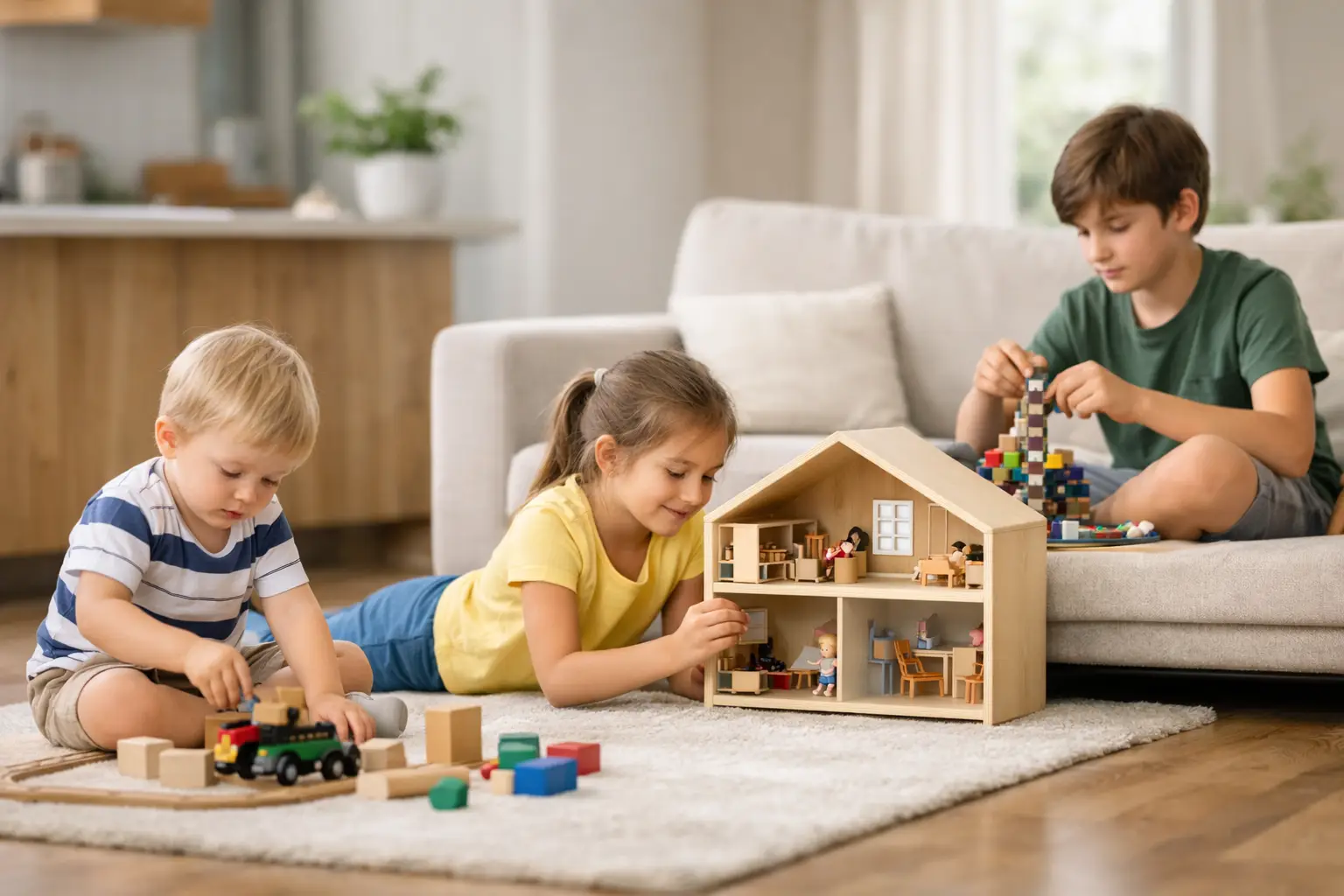
Offer a small, reachable selection that invites action. Open-ended materials work especially well: blocks, animals, dolls, cars, crayons, paper, play dough, dress-up clothes, cardboard boxes, simple puzzles, and age-appropriate books. Rotate some materials every week or two so familiar items feel fresh again.
Keep the first independent-play space near you, especially for younger children. A basket of toys in the kitchen or living room often works better than sending a child alone to a bedroom. Independence grows from felt safety, not isolation.
Give a launch point, then step back
A child who says, “I don’t know what to do,” may need one small starting idea. Try, “Can you make a home for the animals?” or “I wonder how tall your tower can be before it falls?” Then move on to your own task.
The difference is important. A launch point opens a door. Directing every detail walks through the door for them. If you stay and explain the perfect animal habitat, choose the blocks, and correct the tower, your child learns that play requires adult leadership.
When they invite you to join, connect briefly if you can. Look at the creation, ask one genuine question, or play for five minutes before setting a clear limit: “I loved being your customer. Now you keep the store open while I finish dinner.”
Independent play by age and stage
Babies and young toddlers: build trust through nearby exploration
For babies, independent play may look like reaching for a safe toy, examining a textured object, or crawling toward a ball while you sit nearby. A few minutes of supervised floor time is valuable because it lets them follow their own curiosity.
Young toddlers need close supervision and simple options. Put two or three safe items in a basket, sit nearby, and allow them to repeat actions. Dropping, stacking, filling, and emptying are not meaningless activities. They are early experiments in cause and effect.
Avoid expecting long stretches at this stage. Your job is to protect the opportunity to explore, not demand independence beyond your child’s developmental capacity.
Preschoolers: protect imagination from too much instruction
Preschoolers are ready for short, predictable play periods with simple choices. They may enjoy a pretend restaurant, a blanket fort, a car wash with toy vehicles, or an art station with paper and washable supplies.
This age often asks adults to participate because connection is still deeply important. Respond warmly, but do not become the entertainment committee. You can say, “I will help you get the pretend food out, and then you can decide what is on the menu.”
If your preschooler abandons play quickly, shorten the session and remove distractions. Hunger, fatigue, and an active screen in the background can make focused play much harder.
School-age children: make room for projects and problem-solving
Children ages 6 to 10 can begin carrying an idea across several days. They may design a paper city, write a comic, organize a stuffed-animal school, build a fort, create a scavenger hunt, or learn a craft. Give them access to basic materials and permission to make something imperfect.
At this age, independent play can compete with screens. Screens are designed to hold attention without requiring children to generate ideas, tolerate boredom, or solve problems. That does not mean every screen is harmful, but constant access makes self-directed play less likely.
Create screen-free windows before offering entertainment. A child may complain of boredom at first. Boredom is often the uncomfortable pause before imagination begins.
Preteens: redefine play as independent interests
Older children may no longer call it play, but they still need unstructured, self-directed time. Drawing, music, reading, cooking, coding, sports practice, journaling, model building, and creative writing can all serve the same developmental purpose.
Do not dismiss these interests because they are not traditional toys. A preteen who chooses and pursues a meaningful activity is practicing identity, focus, and responsibility. Offer guidance without turning every interest into a performance goal or another item on a resume.
When your child refuses to play alone
A child who constantly demands your attention may be signaling a need for connection, not manipulation. Before insisting on independent time, consider whether they have received a small dose of focused attention. Ten minutes of phone-free connection can make it easier for a child to separate and play afterward.
Try a simple sequence: connect first, then set the boundary. Read one book, play one short game, or sit together on the floor. Then say what will happen next: “Now it is your play time. I will be right here, and I will check on you when the timer rings.”
If they protest, stay calm and repeat the limit rather than negotiating endlessly. Some resistance is normal when a family changes a habit. The answer is not harshness. It is warm, steady follow-through.
Watch for the habits that quietly block independence
Independent play is harder when adults solve every problem, provide constant new stimulation, or interrupt a child who is deeply focused. It is also harder when children only see adults rushing, scrolling, or treating quiet time as unproductive.
Let your child see you read, cook, repair something, garden, or work on a meaningful task. Children learn that alone time can be useful and satisfying by watching the adults around them.
A structured parenting framework such as Raising 4 Dimensional Children in a 2 Dimensional World can help families see these small moments as part of a larger purpose. Independent play is not merely a break for parents. It is daily practice in becoming capable, creative, and emotionally grounded.
Start with one short, protected play period this week. Stay nearby, offer less than you think you should, and notice what your child begins to do when there is room for their own ideas to appear.
Click here to explore parenting resources and tools starting at under a dollar. Equip yourself with knowledge and strategies to raise confident, resilient, and empathetic children.





There are no comments