A child who can spend 45 minutes building a digital world can spend five minutes helping care for the real one. That is why choosing the best chores for children is not mainly about getting help around the house. It is about giving children a place where they matter, where their actions have visible results, and where they practice life beyond a screen.
Chores will not magically end arguments about devices. But they create a healthy counterweight to passive entertainment: movement, competence, contribution, and connection. A child who knows how to sort laundry, feed a pet, clear a table, or make a simple lunch is building the kind of everyday confidence that follows them into adolescence and adulthood.
Why Chores Change More Than the House
Many parents hesitate to assign chores because life already feels rushed. It can seem faster to load the dishwasher yourself than to teach a seven-year-old how to do it without flooding the floor. On a difficult day, it may feel easier to let a child disappear into a tablet than to insist they finish their responsibilities first.
Those choices are understandable. Still, children need more than convenience. They need repeated evidence that they are capable, needed members of the family.
Well-chosen chores develop several parts of a child at once. They strengthen physical skills through movement and coordination. They build mental skills through sequencing, planning, and problem-solving. They support emotional growth because children learn to tolerate boredom, effort, and imperfection. They also build social responsibility: other people benefit when I do my part.
That wider view reflects the 4 Dimensions approach to parenting. When a child has opportunities to grow in more than one area of life, screens stop being the only place where they feel skilled, entertained, or in control.
The goal is not to turn childhood into unpaid labor. The goal is to make contribution a normal part of belonging to a family.
Best Chores for Children Start With Readiness
Age matters, but readiness matters more. Two children of the same age may have very different attention spans, coordination, and willingness to work independently. Start with a task that is slightly challenging but clearly achievable with coaching.
A useful question is: Can my child see when this job is finished? “Help clean up” is vague. “Put all the blocks in this basket” has a clear beginning and end. Clear chores reduce power struggles because children are not left guessing what counts as enough.
Give one instruction at a time for younger children. Demonstrate the job, do it together, then let your child try. Resist correcting every small imperfection. A wrinkled towel still teaches folding. A table wiped with missed spots can be revisited with a calm, specific prompt: “Check the corners before you are done.”
Consistency matters more than difficulty. A small daily responsibility often builds more character than an ambitious Saturday cleaning project that everyone dreads.
Ages 2 to 3: Chores That Build Participation
Toddlers want to imitate the adults around them. Use that instinct. Their jobs should be brief, concrete, and done alongside you. At this stage, the lesson is not precision. It is, “I can help.”
Good choices include putting toys into bins, carrying a diaper to the trash, placing napkins on the table, putting dirty clothes in a hamper, feeding a pet with adult supervision, and helping wipe up small spills. Give toddlers child-sized tools when possible. A small broom or cloth communicates that this is real work, not pretend play.
Keep your language positive and direct. Instead of asking, “Do you want to clean up?” say, “It is cleanup time. You put the cars in the blue bin, and I will put the books on the shelf.” Choice is still useful, but offer it within the responsibility: “Would you like to carry the napkins or the spoons?”
Ages 4 to 5: Chores That Build Routines
Preschoolers can follow simple sequences and take greater pride in being trusted. They can make their bed with help, set the table, match socks, water plants, put away groceries that are within reach, wipe the table, and help sort recycling.
This is also a strong age to connect chores to daily rhythms. Before breakfast, pajamas go in the hamper. Before screen time, toys are put away. After dinner, dishes go to the sink. When chores are attached to predictable moments, parents do not have to negotiate them from scratch every day.
Avoid making every task a paid transaction. An allowance can teach money management later, but basic household contributions should not require a reward each time. Children need to understand that everyone who lives in a home helps care for it. Save payment for occasional extra jobs that go beyond their regular role.
Ages 6 to 8: Chores That Build Competence
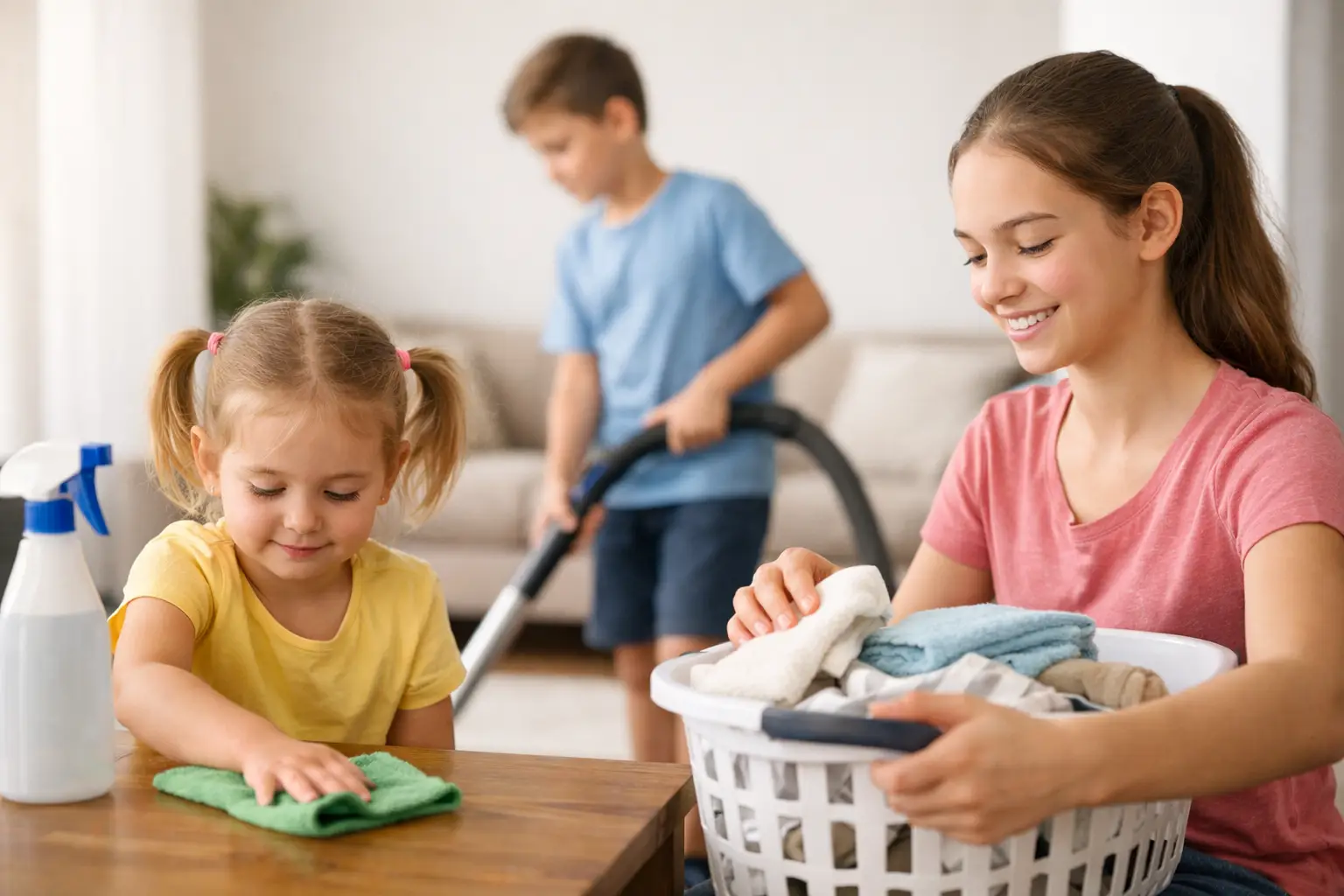
Elementary-age children are ready for jobs with real impact. They can clear and wipe the table, load or unload selected dishwasher items, fold towels, sweep small areas, pack their school bag, make simple snacks, take out small trash bins, and help prepare ingredients for a meal.
This is the age when parents can begin teaching standards without becoming harsh. Explain what “finished” looks like before the work begins. For example: “The counter is clean when crumbs are gone, the cloth is rinsed, and it is hanging to dry.” That is far more effective than saying, “You did not do it right.”
Give your child ownership of one recurring job. Maybe they are responsible for filling the dog’s water bowl each morning or checking that the dining table is ready for dinner. Ownership creates accountability, especially when the task serves someone else.
Ages 9 to 12: Chores That Build Independence
Older children can handle multi-step chores and begin learning practical life skills. They can vacuum, mop a small floor, change bed sheets, do a load of laundry with guidance, empty outdoor trash, wash dishes, prepare a basic breakfast or lunch, and help plan a grocery list.
These years are especially important for families concerned about screen habits. A child who has only digital entertainment waiting after school will naturally gravitate toward it. A child with a predictable routine that includes a snack, a contribution to the household, outdoor movement, homework, and free time has a more balanced structure.
Do not frame chores as punishment for using screens. That makes responsibility feel like a penalty. Instead, make chores part of the normal order of the day: responsibilities first, recreation after. The message is simple: devices are enjoyable, but they do not replace participation in family life.
Ages 13 and Up: Chores That Build Adult Capability
Teenagers need responsibilities that prepare them for independence, not just tasks that keep them busy. They can cook family meals, manage their own laundry, clean bathrooms, mow lawns where appropriate, care for younger siblings in limited situations, shop with a list and budget, and help manage household schedules.
Invite teens into the reasoning behind the work. Explain that running a home requires time, money, planning, and cooperation. They may still complain. That does not mean the chore is wrong. Adolescents are learning to balance personal freedom with obligations to other people, a lesson that will serve them in college, work, friendships, and future families.
How to Make Chores Stick Without Constant Nagging
A chore system fails when it depends on a parent repeating the same request six times. Make expectations visible and predictable. A simple family chart can help, especially for younger children, but it should support the routine rather than become another complicated project to manage.
Choose a small number of non-negotiable responsibilities. Three regular chores done consistently are better than ten chores that disappear after a week. Build in natural consequences when possible. If clean clothes are not placed in the hamper, they may not be available on laundry day. If a child leaves their snack mess behind, the next activity waits until it is cleaned.
Notice effort specifically. “You remembered the pet’s water without being asked” builds more motivation than a generic “good job.” It tells your child exactly what responsible behavior looks like.
Also expect resistance at times. Children are tired, distracted, and still developing self-control. Stay calm, keep the expectation, and offer support without taking over. You are not merely trying to get the kitchen clean. You are teaching your child that they can meet a responsibility even when they would rather do something else.
A home where children contribute is not a perfectly tidy home. It is a training ground for capable, grounded young people. Start with one job your child can do this week, teach it with patience, and let them feel the quiet pride of being needed.
Click here to explore parenting resources and tools starting at under a dollar. Equip yourself with knowledge and strategies to raise confident, resilient, and empathetic children.





There are no comments