Your child knocks over a sibling’s block tower, shrugs, and walks away. In that moment, many parents ask the same question: how to teach empathy to children when kindness does not seem to come naturally. The answer is not a single lecture or forced apology. Empathy is built over time through modeling, practice, language, and repeated chances to notice what other people feel.
For parents, this changes everything. Empathy is not just about raising a “nice” child. It supports emotional regulation, friendship skills, conflict resolution, and even better behavior at home. When a child can recognize another person’s experience, he or she is more likely to pause, think, and choose wisely. That makes empathy part of a child’s emotional development, not a side lesson.
Why empathy must be taught on purpose
Some children seem naturally sensitive to others. Others are more impulsive, more self-focused, or slower to read social cues. Both are normal. Empathy has roots in temperament, but it also grows through guidance.
That is why parents should not confuse empathy with personality. A loud child can be deeply empathetic. A quiet child can still miss how others feel. What matters most is whether a child is being taught to notice, name, and respond.
Empathy also develops in stages. A toddler may cry when another child cries, but still grab a toy without hesitation. A grade-school child may understand that a friend feels left out, yet not know what to do next. A preteen may care deeply, but hide it to fit in. Teaching empathy works best when you match the lesson to the child’s developmental level.
How to teach empathy to children at different ages
Parents often want one method that works from toddlerhood through the teen years. Real life is not that neat. The principle stays the same, but the practice changes with age.
Toddlers and preschoolers
At this stage, empathy begins with simple emotional awareness. Young children live close to their own needs. They are not being selfish in a moral sense. They are still learning that other people have separate feelings and experiences.
Use short, concrete language. If your toddler hits, skip the long speech. Try, “Look at her face. She’s sad. Hitting hurts.” Then guide a repair: “Let’s bring her the toy,” or “Let’s check if she’s okay.” The goal is not shame. The goal is connection between action and impact.
Pretend play helps more than many parents realize. Dolls, stuffed animals, and simple role-play let children practice caregiving in a safe way. “Bear fell down. How does Bear feel?” may sound basic, but this is how emotional understanding grows.
Elementary-age children
This is a prime window for stronger empathy teaching because children can now think more clearly about cause and effect. They can understand that the same event feels different to different people.
Ask reflective questions after everyday moments. “How do you think your brother felt when you interrupted him?” “What do you think your classmate needed in that moment?” These questions train perspective-taking, which is one of the core skills behind empathy.
Books and movies are useful here, but only if parents go beyond the plot. Ask what a character might have feared, wanted, or misunderstood. Children do not automatically make these connections. They need help reading below the surface.
Preteens and teens
Older children need less correction in the moment and more conversation that respects their growing independence. They can handle nuance. They can understand mixed motives, social pressure, exclusion, embarrassment, and the gap between intention and effect.
Talk about real situations without turning every discussion into a sermon. If your child sees cruel behavior online, ask, “Why do you think people join in?” and “What happens to someone on the receiving end?” If your child makes a hurtful choice, move beyond “That was wrong.” Ask, “What do you think was going on in you, and what do you think happened in the other person?”
This age also benefits from responsibility. Caring for younger siblings, helping neighbors, volunteering, and contributing meaningfully at home all strengthen the habit of considering others.
The daily habits that build empathy fastest
Parents usually teach empathy best in ordinary moments, not formal lessons. Small patterns repeated daily shape a child’s emotional world.
First, model it. Children learn more from what you do than from what you announce. If you speak respectfully to a tired cashier, show patience with an elderly relative, or acknowledge your child’s disappointment even while holding a boundary, you are showing empathy in action. If you want a child who listens to others, let them regularly see you listen.
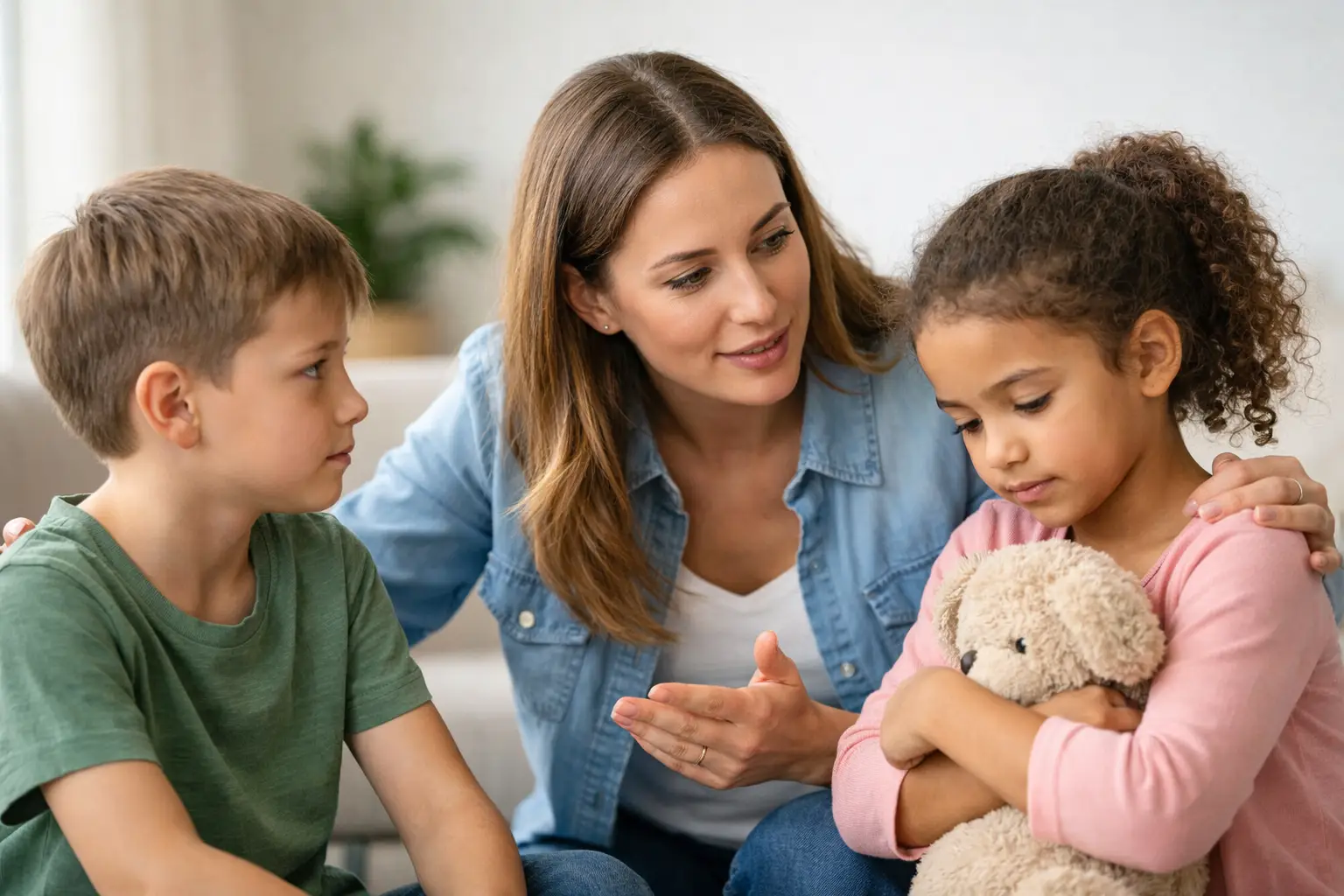
Second, name feelings without rushing past them. When a child is upset, many adults move straight to fixing, minimizing, or correcting. A better starting point is, “You’re frustrated,” or “That felt unfair to you.” Children who feel understood are more able to understand others. Emotional security and empathy are closely connected.
Third, teach repair. Empathy is not complete until it leads to action. A forced “sorry” may stop the noise, but it does not always change the heart. Help your child ask, “What can I do now?” Sometimes repair means an apology. Sometimes it means replacing what was broken, including someone in play, writing a note, or giving space.
Fourth, reduce constant distraction. Children who spend all day reacting to screens, noise, and fast entertainment may have fewer opportunities to notice tone, facial expression, and subtle emotional cues. This does not mean every screen is harmful. It does mean empathy grows best where there is conversation, eye contact, shared work, and unhurried family life.
What gets in the way of empathy
If you are trying hard and not seeing quick results, that does not mean you are failing. Several common barriers can slow this skill.
Overprotection is one. When parents solve every conflict immediately, children miss the chance to feel another person’s perspective and make things right. Support matters, but so does letting children sit with the impact of their behavior.
Another barrier is shame-heavy discipline. If every mistake turns into “What is wrong with you?” children become defensive. Defensive children protect themselves before they consider others. Firm accountability works better when paired with calm clarity: “That choice hurt someone. Let’s talk about what happened and how to repair it.”
Stress matters too. A dysregulated child has less capacity for empathy in the moment. Hunger, fatigue, anxiety, sibling conflict, and overstimulation can all narrow a child’s focus to self-protection. This is why empathy cannot be separated from the full picture of development. Physical, mental, emotional, and spiritual growth all affect how a child treats others. A holistic framework like the one behind Raising 4 Dimensional Children in a 2 Dimensional World matters because children do better when parents address the whole child, not just isolated behavior.
Practical scripts parents can use
Parents often know what they want to teach but freeze in the moment. A few simple scripts can help.
When your child hurts someone, try: “Pause. Look at their face. What do you notice?”
When your child is dismissive, try: “You don’t have to feel what they feel to understand that it matters.”
When siblings fight, try: “Tell me what happened from your side. Now let’s hear your brother’s side.”
When a child feels no remorse yet, try: “You may not understand it fully yet, but you are still responsible for making it right.”
These are simple, but that is the point. Parents need language they can actually use in real life.
When empathy looks different than expected
Not all empathy is warm and expressive. Some children show care through actions more than words. Others need more time to process before they can respond well. Neurodivergent children, especially those who struggle with social cues, may need more direct teaching and clearer explanations. That does not mean they are incapable of empathy. It means they may learn it through a different route.
This is where patience becomes part of the instruction manual you never got. If your child does not immediately say the right thing, do not assume the lesson is lost. Keep teaching. Keep modeling. Keep giving chances to practice.
A child who learns to notice pain, take responsibility, and respond with care is developing more than manners. That child is gaining the kind of emotional strength that supports healthy friendships, wiser decisions, and deeper character for years to come. Start small, stay steady, and trust that the quiet work you do at home is shaping someone the world will be grateful to know.
Click here to explore parenting resources and tools starting at under a dollar. Equip yourself with knowledge and strategies to raise confident, resilient, and empathetic children.





There are no comments